The heart behind
Wondering Ways
Every child has a way of experiencing the world that's worth understanding. At Wondering Ways, we follow the child's lead, not a curriculum, a protocol, or a fixed endpoint.
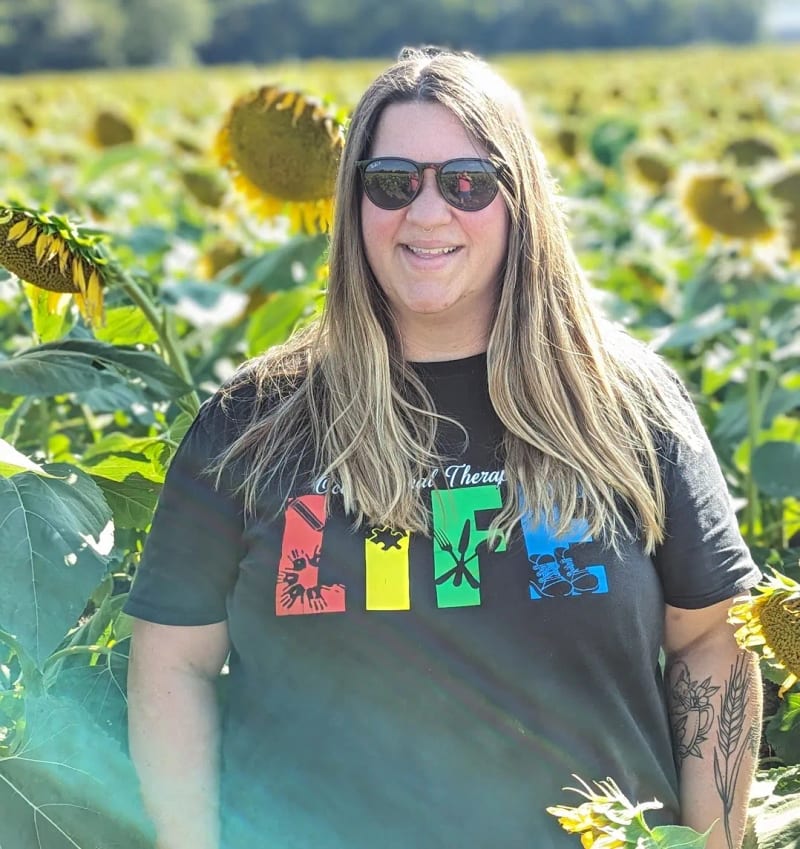
Hi, I'm Kaylen
I started Wondering Ways after years of working in pediatrics as an OT. I've been in clinics, schools, homes and daycares through early intervention. I started as most new graduate OT's do, having the importance of meeting goals drilled into us. For years I thought I had to be directly eliciting goals during every therapeutic moment as the only way to make progress.
As time went on, I kept noticing the same thing: the kids who made the most growth weren't the ones following the structured protocol and therapist's agendas. They were the ones who had a therapist who'd attuned to the child, gotten to know them, who followed their cues, and noticed their unspoken communication. DIR/Floortime gave me a framework for why that was, and how to be intentional in following the gleam in the eye.
DIR/Floortime means I'm paying attention to what captures your child's interest, what helps them feel regulated and safe in their body. As I learned to tune in and connect I have watched the skills develop. I learned how to incorporate yucky activities like handwriting and visual tracking (come on, nobody likes to do things over and over again when they are "bad" at them) and how to playfully create a sign for the business we formed together in therapy, instead of drills and worksheets.
Through this shift I have watched magic happen.
Outside of sessions, I spend a lot of time in continuing education. I've had the privilege of learning from some incredibly talented women over the years. Women who are movers and shakers in the OT community. I love finding connections and pathways to find the deeper why and discussing child development. My innate curiosity leads me into deep rabbit holes following my interests. I enjoy driving back roads with the windows down, wrangling my dogs on the farm, and watching the cows mosey about. I love getting lost in a fantasy world through books and movies. I have a constant sense of wanderlust, and am ready to go exploring at any time.
- Master's in Occupational Therapy
- DIR/Floortime Certified Practitioner
- Trauma-Informed Approach
How I Came to DIR/Floortime
I slowly tiptoed my way into the DIR/Floortime world. In my early years I found myself feeling professionally stuck, specifically with the early intervention population in the homes. I would come in with my agenda, carrying my giant laundry basket of toys for us to explore and be completely befuddled that a child wouldn't want to interact with me. I would put on a one woman performance and feel frustrated that I wasn't "getting anywhere". I used all the tools in my toolbox at the time, and implemented every behavioral strategy I knew, and was shocked when I would get bitten or scratched (If only I could go back and hold younger Kaylen and tell her there is a better way, and deeply apologize to some children for not knowing how to tune in to their needs).
One of my coworkers invited me to attend DIR 101. Sitting in the classroom that day I had a sense of coming home, and felt like I could breathe deeply for the first time as a practitioner. At that moment, I understood that this was the community I needed to be a part of.
Moving forward a few years, and I was finally ready to take on DIR 201. My first deep dive into the DIR/Floortime world, it was humbling and at times uncomfortable, as it is to unlearn and grow. DIR/Floortime played a part in deciding to move my family from Tennessee to Kansas. I had the privilege of working at a DIR/Floortime accredited organization, where I was able to collaborate and have deep and meaningful discussions in an interdisciplinary setting. It was incredible to be immersed in an affirming and curious environment. I continue to stay in this world through conferences, CEU's, mentorship etc. and am currently working my way through DIR 203 (Advanced practitioner).
Get Curious
Behavior is communication. When we stop asking "how do I get them to stop doing that" and start asking "what is this telling me," the whole picture changes.
Being neurodiversity-affirming means we're not trying to make your child fit a neurotypical mold. We're trying to understand their nervous system, support their development, and help your family feel less alone in navigating it.
Child-Led Play
Co-Regulation
Humor & Connection
Neurodiversity Affirming
Our Philosophy
DIR/Floortime isn't a technique we layer on. It's the lens through which we understand what a child needs and why.
Follow the Child's Lead
Sessions start with what the child is interested in, not what's on a goal sheet. Interest drives attention, and attention is where learning actually happens.
Relationship First
A child who doesn't feel safe with their therapist isn't going to learn much from them. Building that relationship isn't a warm-up to the real work. It is the real work.
Family as Partners
Parents hold the most context. What happens in sessions needs to make sense in your home, your morning routine, and your child's school, not just in our room.
What is DIR/Floortime?
DIR/Floortime is a framework developed by Dr. Stanley Greenspan and Dr. Serena Wieder, with ongoing research and training through the ICDL. DIR stands for Developmental, Individual-differences, Relationship-based, the three dimensions that shape how we understand each child. Rather than targeting isolated skills, it works to build the functional emotional developmental capacities: staying engaged, communicating intentionally, solving problems with another person, and thinking symbolically. Sessions look like play because that's the medium through which these capacities develop.
Evidence-Based Practice
DIR/Floortime has a documented research base, with studies showing gains in social communication, adaptive behavior, and family interaction patterns. The ICDL maintains a research library at icdl.com if you want to read the underlying studies.
Social Emotional at the Core
Motor skills, attention, and academic readiness all depend on a regulated nervous system and a sense of safety in relationship. That's not a philosophical stance. It's what the developmental science consistently shows.
Want to talk through whether this is the right fit?
Book a free 20-minute call. We'll ask about your child, answer your questions, and be straightforward about what we think would help.